AI in customer service: why human employees remain indispensable

Gartner - Fortune 500

According to research and consulting firm Gartner, no Fortune 500 company will have completely agentless customer service by 2028. Despite the rapid growth of AI in customer service and far-reaching automation, the human factor remains crucial to customer experience and loyalty. Where AI is often predicted to completely replace the human customer service representative, Gartner […]

How does RPA work in small organizations?
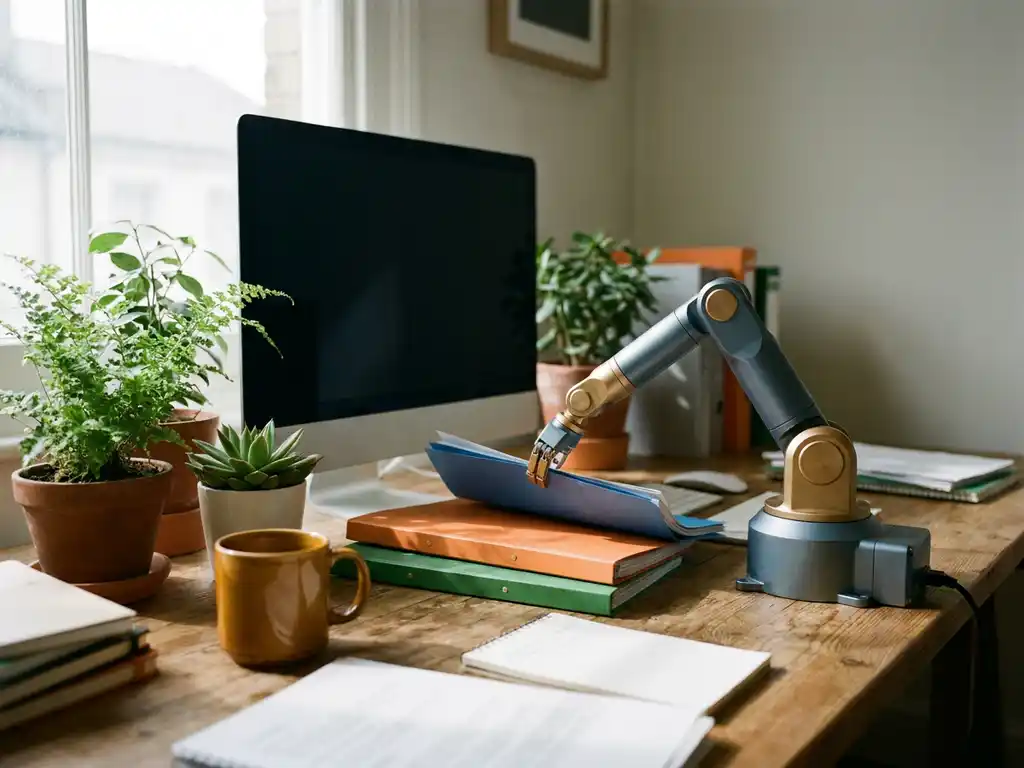
Klein robotarm sorteert kleurgecodeerde mappen op een opgeruimd bureau met planten en monitor in warm-blauw kantoorlicht.

RPA (Robotic Process Automation) transforms small organizations by automating repetitive tasks with software robots that work 24/7 without errors. These digital assistants instantly cut costs – often less than a part-time employee but with full-time productivity. Start with simple processes like invoice processing or data capture and recoup your investment within 6-12 months. Modern RPA solutions have become modular and affordable, giving smaller companies access to this technology that frees employees from tedious administration.

How do you calculate RPA investment payback?

Calculating the payback period for RPA seems complex, but with the right approach, you’ll gain clear insight into your investment. On average, organizations recoup their RPA costs within 6 to 18 months, with a healthy ROI of 200-400% over three years. A typical bot saves €80,000 to €200,000 per year by eliminating repetitive tasks. However, many companies underestimate hidden costs such as change management and integration challenges. Learn the step-by-step ROI calculation and find out why some projects are more expensive than expected.

What are the risks of sticking with legacy telephony?

Legacy telephony systems are becoming exponentially more expensive due to scarcity of specialists and rising parts costs. Outdated systems such as Avaya and Mitel have serious security vulnerabilities due to missing updates and weak encryption, causing data breaches and compliance issues. Employees lose productivity due to lack of mobile integration and modern features, while customers experience frustration due to fragmented communication channels. Maintenance costs rise every month, security risks increase and hybrid working becomes almost impossible. The question is not whether to switch, but when the cost of delaying becomes too high for your business.

Download the white paper here

Deepen your knowledge with Pegamento’s white papers.

Ernst Vegter-Business consultant Pegamento

Ernst Vegter

Business Consultant

Hospitality is one of my deepest motivations.
Not surprisingly, of course, customer service is a common thread in my career. Aspects of hospitality is being able to connect, to facilitate but mainly to make someone feel genuinely welcome. My intuition is my greatest asset to be able to put myself in the shoes of a guest. A customer is my guest.

Fed by various senses, an image forms around the client. I listen to what is being said, watch facial expressions, taste the underlying tone and get a feel for the challenge to be addressed. An image literally forms on my retina. I have to be able to see it. If I can see it, I can create it.

In this, the trick is to pursue simplicity, give the client a warm feeling that the problem is understood, receive good advice, facilitated and carefully guided to the solution. Trust, connect and unburden.

The feeling when a guest arrives at your hotel after a long tiring journey, can sit in front of the fireplace, be handed a good glass of wine and stare carefree at the fire. My guest knows it will be okay.

This piece was written by Ernst Vegter, working as a Business Consultant at Pegamento.

Ger Koedam-Communication & Marketing Pegamento

Ger Koedam

Marketing & Communications

How can I help you? That’s pretty much the first question I ask when talking to people who are curious about our services. In such a conversation, the use of senses is very important. Because not everyone is the same. One person thinks in images, while for another words are important or how something feels. For me, sight and hearing are the most beautiful senses, because both eyes and ears absorb information and can convey or process emotions.

Why hearing? Because listening is essential in contact. And it’s the key to unlocking valuable insights.

I developed this skill early on. As a child, I enjoyed radio plays on the radio, bringing the stories to life in my head.

Rob Roode-Research Development

Rob Roode

Research & Development

Recognizing and automating patterns. Tasks we are constantly working on when implementing our robots at Pegamento. My 2 Drentsche Patrijshonden are hunting dogs and certainly not robots. The hunting instinct and intuition is basically in their genes. Continuing to offer new forms of training has taught them to recognize and act independently in hunting situations. Even “unsupervised,” even if I’m not around.

But when you try to teach a brain something, it also starts to see things you don’t expect. Dogs pick up on the slightest deviation in your voice or directions. To start recognizing that and correcting it again is perhaps the most complex challenge. But in our work, for the wonderful clients for whom we get to work, it often yields the most beautiful new insights!

This piece was written by Rob, founder of Pegamento and in charge of Marketing and R&D.

Serge Poppes-CEO Pegamento

Serge Poppes

CEO

Feeling. That’s the best thing Pegamento stands for. Feeling for technology in the broadest sense of the word. Not only feeling for the exciting stuff like AI, but also for the basics of communication.

The very best part of my job is selling, listening, translating and thinking about what really matters. We bring the digital transformation with a great team!
The diversity of our team, how sharp we are, but especially the wonderful things we get to make makes me feel extremely good. Hence, I intuitively chose the sense of “feeling.

Feeling gives life and differentiation!