AI in customer interactions is getting smarter at lightning speed. But a better language model alone doesn’t guarantee better customer service. The real breakthrough comes when AI understands who the customer is, what’s going on at that moment, which information is reliable, and what action is needed. Context is what sets apart a chatbot that simply provides an answer from an AI agent that actually helps.
In recent years, many organizations have been introduced to chatbots. At first, these were primarily systems that attempted to find an answer based on fixed decision trees. With the advent of generative AI, that picture changed fundamentally. Bots now understand natural language better, express themselves more clearly, and can answer much more complex questions.
The next step is now on the horizon: the AI agent.
Such an agent must not only converse but also be able to reason independently, retrieve information, initiate processes, and carry out actions. Think of processing a change of address, rescheduling an appointment, checking on a delivery, or investigating a malfunction.
That sounds like a huge step forward. And technically speaking, it is.
But there’s a catch.
Because an AI agent that doesn’t know what’s happening within the organization and around the individual customer will ultimately remain, above all, a very intelligent conversation partner.
The problem is often not the AI
A striking conclusion emerged during the recent Belgian event “AI in Customer Contact.” Many AI projects deliver less than organizations initially expect. Not because the available AI models aren’t powerful enough, but because context is lacking.
Systems, data, and processes are not sufficiently interconnected. As a result, an AI assistant may provide an excellent general answer, but it does not know, for example, that this specific customer’s order has been delayed, that the same customer called yesterday, or that there is currently a system outage.
That difference is crucial.
Suppose you ordered a gift online that you need tomorrow. The shipping carrier knows the package is delayed. The online store has your order on file. The CRM system contains your contact information. And perhaps an employee already made a note yesterday because you contacted them earlier.
So all the information already exists.
But when that data is scattered across different systems and isn’t consolidated into the customer contact process, every interaction starts from scratch.
The chatbot tells the customer what the normal delivery time is.
The employee asks for the order number again.
The customer explains again why the delivery is important.
Each individual step may be technically sound, yet the overall customer experience is still poor.
That’s not an AI problem.
That’s a context problem.
From knowledge to current context
Good AI therefore starts with good knowledge.
An organization must know which information is reliable and up-to-date. Procedures, product information, work instructions, and answers to customer questions must be validated and made available in a single, consistent manner.
But knowledge alone isn’t enough.
An AI agent also needs up-to-date information about the customer’s situation. Is an order on its way? Is there an outstanding payment? Is there a service disruption? Which products does this customer use? What agreements have been made previously?
On top of that comes process context. An AI agent must not only know the answer but also what needs to happen next.
Can the customer change an appointment themselves?
Is additional verification required?
When should a case be created?
When should an agent take over the conversation?
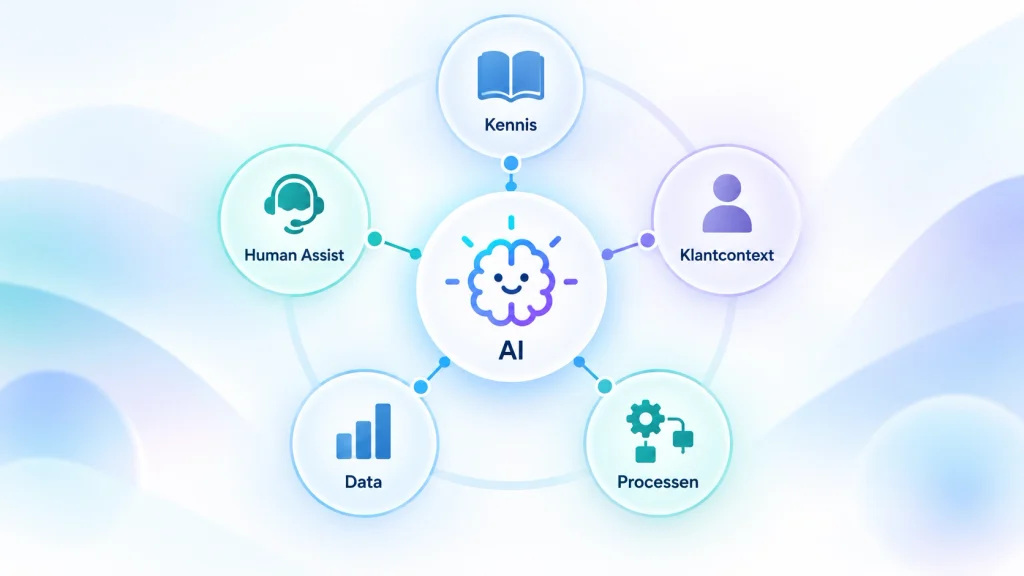
Only when knowledge, customer information, and processes come together does AI transform from an answer machine into a service tool.
Dutch practices demonstrate various models
It is interesting to note that Dutch organizations are now applying this development in various ways.
At VGZ, the AI assistant Aimy supports employees during phone calls by automatically providing relevant information from the knowledge base. The employee continues to handle the call but spends less time searching for information.
Landal takes a different approach. Within its guest service call center, calls are first answered by Voice AI. The technology identifies the guest, creates a case, and transfers the call to an employee when necessary.
The transportation company Qbuzz combines the best of both worlds. The AI assistant Quby provides direct assistance to passengers, uses real-time travel information from Qbuzz’s systems, and simultaneously supports employees. When a question becomes complex or emotional, the relevant context is shared with the employee. This means the passenger doesn’t have to repeat their story.
Three applications, but the same underlying principle:
AI only truly delivers value when technology, knowledge, customer context, and employees work together.
The human element is part of the design
This brings us to a second crucial aspect of context: understanding when AI is not the best solution.
A customer who asks what time a bus leaves needs, above all, a quick and accurate answer.
Someone who is upset because they missed an important appointment due to a system failure needs something else.
An organization that focuses exclusively on the percentage of calls handled by AI therefore runs the risk of optimizing the wrong KPI. A high percentage of automated interactions says nothing about the quality of the experience.
The better question is:
Did the customer have their problem resolved as effectively as possible?
Sometimes AI does this completely on its own. Sometimes AI supports an employee. And sometimes technology actually needs to give way quickly to human interaction.
That’s why human intervention shouldn’t be a stopgap measure added to a chatbot later on. It should be part of the design of the customer contact process from the very beginning.
Including the context that has already been established.
Because a customer who, after five minutes with an AI agent, finally reaches an agent and then has to explain their name, customer number, and issue all over again does not experience integrated customer contact. They experience two separate systems.
Context Enables Proactive Service
The most interesting developments occur when organizations take it one step further.
With sufficient up-to-date context, AI doesn’t always have to wait for the customer to ask a question.
If an organization knows that an order is delayed, it can inform the customer before they reach out.
If an appointment can’t take place due to a disruption, an alternative can be suggested.
If a system detects that a request is getting stuck, it can proactively offer assistance.
This shifts customer contact from responding to questions to preventing questions from arising in the first place.
That may well be a much bigger change than the chatbot itself.
After all, customers usually don’t want to contact customer service at all. They just want things to be taken care of.
Knowledge management is becoming more important, not less important
The rise of AI sometimes leads to the idea that traditional knowledge bases are becoming less important. The opposite is true.
The more autonomous AI becomes, the more important it is that the information on which AI relies is reliable, validated, and up-to-date.
An employee who finds incorrect information in a knowledge base can still have doubts and ask for clarification. An AI agent, however, can convincingly repeat that same incorrect answer hundreds of times in a short period of time.
Good knowledge governance is therefore a prerequisite for effective AI.
Who is authorized to edit information?
Which source is authoritative?
When is information considered outdated?
Which responses can be automatically provided to customers?
And for which topics must human review always take place?
The model’s intelligence does not change those fundamental questions.
In fact, the more powerful the technology, the more important these questions become.
So don’t start with the chatbot
Organizations currently considering AI in customer interactions should therefore not start by asking:
Which AI agent should we choose?
A better question is:
Which customer journey do we want to improve, and what context does AI need to actually add value there?
Only then should you consider the technology choices.
What knowledge sources are needed? What customer data can be used? Which CRM, ERP, or back-office systems need to be integrated? Which processes can AI carry out independently? When should an employee take over? And how do we measure whether the customer is actually being served better?
That might sound less spectacular than the latest AI demo.
But that is precisely where the difference lies between an interesting pilot project and an application that can actually become part of day-to-day operations.
From Smart Bot to Intelligent Customer Interaction
AI models will undoubtedly become much more powerful in the coming years. Conversations will become more natural, voice AI will improve, and AI agents will be able to perform more and more tasks independently.
But even the best language model in the world can’t know that your customer called three times yesterday if no one makes that information available.
It can’t know that a delivery is delayed if it doesn’t have access to up-to-date logistics information.
And it can’t take appropriate follow-up action if the customer contact process isn’t set up properly.
That’s why true innovation isn’t just about AI.
It lies in connecting people, knowledge, processes, channels, and data.
After all, an AI agent without context is, at best, just a smarter chatbot.
With the right context, it becomes an integral part of good customer service.
Background information can be found at:
– Everything about AI-driven intelligence
– Achieve the optimal customer experience
– Using Agentic AI for customer service