
AI Literacy: Why Understanding What AI Does Is More Important Than Knowing How to Use It

These days, anyone can get started with AI. Whether you’re writing a text, summarizing a report, creating an image, or answering a customer’s question, a few instructions often yield a convincing result in just a few seconds. But do we actually understand what lies behind that result? And more importantly: can we recognize when AI […]
There is no such thing as the best AI model. But there is the best model for your application.

Every time a new language model is introduced, the same thing happens. In no time at all, benchmarks, rankings, and comparisons start appearing. One model is better at reasoning, another scores higher in programming, and a third is cheaper or faster. And then the almost inevitable debate arises: which AI model is actually the best? […]
An AI agent without context is just a smarter chatbot

AI in customer interactions is getting smarter at lightning speed. But a better language model alone doesn’t guarantee better customer service. The real breakthrough comes when AI understands who the customer is, what’s going on at that moment, which information is reliable, and what action is needed. Context is what sets apart a chatbot that […]
AI Act: Starting August 2, it must be clear when customers are talking to AI

The European Commission has published new guidelines on the transparency requirements under the AI Act. Starting August 2, 2026, organizations must make it clear when someone is communicating directly with an AI system. For customer interactions, this has direct implications for the use of chatbots, voicebots, and digital assistants. AI is increasingly becoming part of […]
August 2026 is fast approaching: Will your AI-powered customer interactions comply with the law by then?

Many organizations are now experimenting with AI in customer service. Voicebots answer questions, AI agents schedule appointments, and smart assistants support or replace parts of the customer service process. The benefits are clear: lower costs, better accessibility, and faster service. But while most of the attention is focused on the possibilities of AI, many organizations […]
AI is growing rapidly. But the real shortfall is not in technology, but in practical experience.

According to recent figures from Statistics Netherlands, one in six Dutch companies now uses AI. That is a doubling compared to two years earlier. Especially applications around marketing and sales stand out: of the companies that use AI, 35% use it for that purpose. Text mining, natural language generation and speech recognition are also clearly […]
How do you get started with RPA in 2025?
Implementing RPA (Robotic Process Automation) in 2025 starts with identifying repetitive, rule-based processes that are time-consuming. Start small with one high-volume process, such as invoice processing or data migration between systems. Choose software that fits your technical capabilities, involve your team from the beginning and work with a clear roadmap: process analysis, pilot project, testing, rollout and optimization. Most organizations see initial results within 3-6 months with 40-80% time savings on automated tasks. RPA is software that mimics human actions to perform repetitive computing tasks automatically. These digital robots can log into systems, copy data between […]
Why Lisanne Buik’s keynote was more than a story about AI

Between man and machine On April 15, 2026, Lisanne Buik stood before a room full of professionals at the Spoorwegmuseum in Utrecht during an event organized by Pegamento. It could have been a keynote like so many given on artificial intelligence: full of charts, future scenarios, tools, models and warnings about what organizations should not […]
Pegamento launches BreathSense AI: real-time emotion recognition via breathing in customer conversations
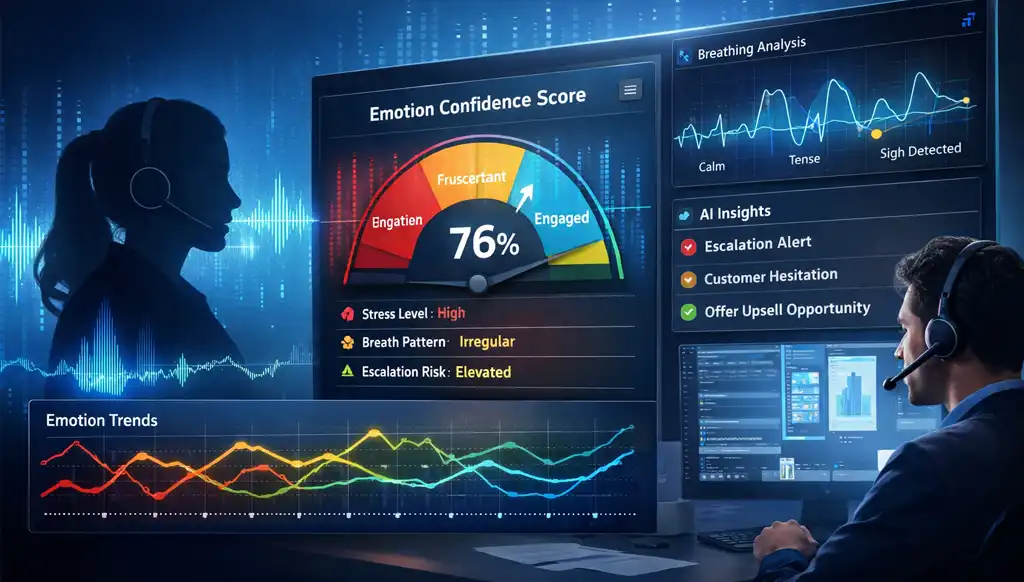
Update: Based on the responses, we’ve noticed that BreathSense AI came across as quite convincing. So, just to be clear: this concept was our April Fools’ Day prank for 2026. The fact that so many people immediately thought it was possible perhaps says more about just how quickly AI is developing these days. Pegamento as […]
The future of customer contact: This is how AI will become the engine of meaningful service in 2030

Customer contact is evolving faster than ever. Where contact centers ran on scripts, wait times and handling times for years, a whole new era is now emerging.In 2030, customer contact is no longer a cost, but a core strategic function that helps organizations grow, innovate and remain distinctive. At Pegamento, we see this movement on […]