
What De Luisterlijn Teaches Us About Attention, Empathy, and Better Customer Service
Listening seems simple. Someone says something, you hear it, and then you respond. Yet we all know that in practice, things often go differently—especially when it comes to customer interactions, collaboration, or leadership. Before you know it, you’re already solving problems, giving advice, filling in the blanks, or asking follow-up questions based on your own agenda.
But truly listening requires something else. It requires attention. Slowing down. And the willingness to put the other person first for a moment, rather than yourself.
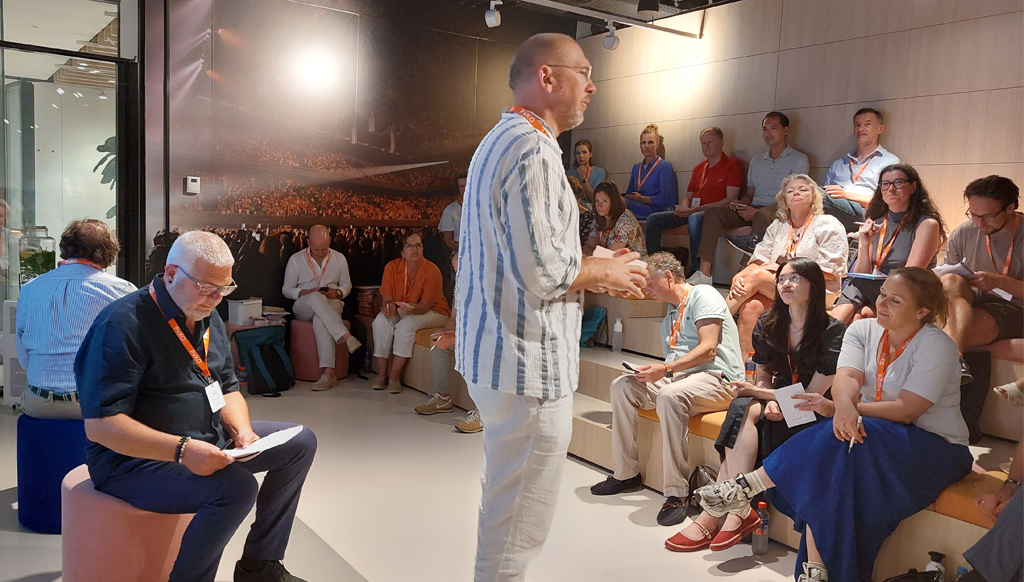
That was the topic of the workshop “The Art of Listening,” which De Luisterlijn organized in collaboration with Pegamento on Friday, July 26, 2026, at the initiative of the trade union PvKO. The event took place at VodafoneZiggo in Utrecht and brought together about forty professionals from organizations including BOVAG, VGZ, Greenchoice, PostNL, and TUI.
Outside, it was tropically hot. Inside, there was a cool and peaceful setting for a morning devoted to what is perhaps the most important skill in human interaction: listening.
Why Listening Is So Much More Than Just Hearing
De Luisterlijn knows better than anyone what it means to listen. Every day, volunteers talk with people who need a listening ear—not to find an immediate solution, but simply to be heard—without judgment, without rushing, and without anyone immediately taking over the conversation.
That premise was central to the workshop.
Because in many conversations—including those with customers—emotions are always present. Sometimes they’re clearly visible; other times, they lie just beneath the surface. A customer might sound angry, but actually feel insecure. Someone might respond curtly, but really just feel misunderstood. That’s exactly when the way you listen makes all the difference.
Those who listen only to be able to respond often miss what’s really going on. Those who listen attentively hear more than just words.
Practicing with Real-Life Situations

The workshop wasn’t just about theory. Volunteers Marco and Eppo from De Luisterlijn led the participants in a role-playing exercise. Afterward, the attendees were asked to identify what worked well, what didn’t help, and what effect that had on the conversation.
That immediately made it clear just how subtle listening is. A well-intentioned solution can come too quickly. A question can create space, but it can also steer the conversation. A brief silence can feel uncomfortable, but it may actually be necessary to let the other person continue speaking.
Thus, listening was not presented as a gimmick or communication technique, but as a skill that you can consciously develop.
The Benefits of Truly Listening
For organizations, listening is more than just a soft skill. It directly impacts the quality of customer interactions, collaboration, and trust.
If you listen more carefully, you’ll be able to recognize what someone needs more quickly—not just the surface-level request, but also the underlying need. This leads to better conversations, less noise, and a deeper connection.
The key takeaways from the workshop:
- True listening begins with attention, not with a response.
- Emotions are not a disruption to the conversation, but rather important information.
- Silence can sometimes be more valuable than a quick response.
- Listening without judgment gives the other person space.
- Responding thoughtfully works better than resolving issues automatically.
Especially at a time when technology, AI, and automation are becoming increasingly important in customer interactions, this human skill remains essential. Because no matter how smart systems become, trust is still built through human interaction.
Learning Together with De Luisterlijn
For Pegamento, this workshop was a wonderful combination of customer engagement, social responsibility, and collaboration. Every day, De Luisterlijn demonstrates just how powerful genuine attention can be, and PvKO brought together professionals who want to apply this in their own practice.
Afterward, the participants received a special handout with exercises and insights to help them continue practicing at home or at work. After all, listening isn’t something you can learn in a single morning. It requires repetition, awareness, and a willingness to keep trying.
The most important lesson?
True listening begins the moment you stop thinking ahead about what you want to say.