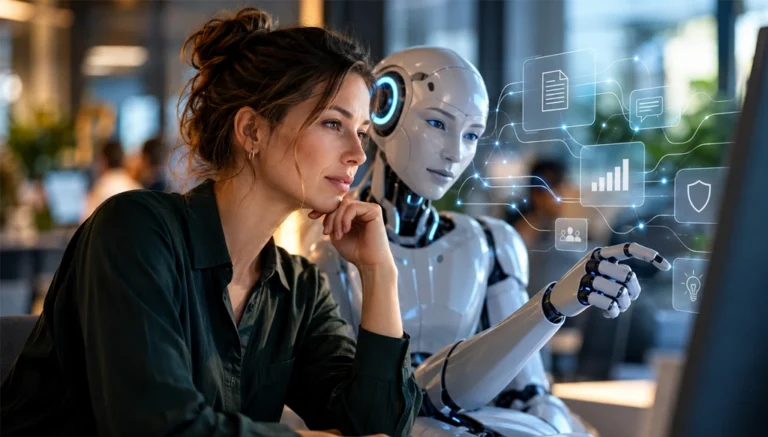
AI assistants automate email handling by intelligently analyzing, categorizing and responding to incoming messages without human intervention. These systems use natural language processing to understand the content and intent of emails, then automatically take appropriate actions such as generating responses, referring them to the appropriate departments or scheduling follow-ups. Modern AI assistants can handle up to 80% of standard customer queries independently.
What are AI assistants for email handling and how do they work?
AI assistants for email handling are intelligent systems that automatically process and respond to incoming emails. They combine natural language processing, machine learning and automation algorithms to mimic and improve human email handling.
These systems work in several steps. They scan incoming emails and analyze the content, tone and context of the message. Using pattern recognition, they recognize common question types and can assess the urgency and emotional charge of messages.
The underlying technology consists of several components. Natural language processing handles text comprehension and interpretation, while machine learning algorithms continuously learn from new emails and make improvements. Automation rules determine which actions are taken in specific scenarios.
After analysis, the AI assistant determines the best follow-up action: generate an immediate response, refer to a specialist or mark the message for human review. These decisions are made based on predefined rules and learned patterns from historical data.
What email tasks can AI assistants fully automate?
AI assistants can fully automate a wide range of e-mail tasks, from simple sorting to complex customer interactions. They especially excel at repetitive tasks that follow clear patterns.
Automatic categorization and routing forms the basis of automated e-mail handling. The system sorts incoming messages by subject, urgency and expertise needed, then sends them to the appropriate departments or employees. This eliminates manual sorting and significantly reduces response times.
Standard answers are generated for frequently asked questions about opening hours, prices, procedures or product information. The AI assistant recognizes these question types and immediately sends an appropriate, personalized answer without human intervention.
Urgency detection and escalation ensure that important messages are prioritized. The system recognizes signal words, emotional language and customer history to determine which emails require immediate attention.
Follow-up management automates reminders and follow-up actions. The AI assistant keeps track of which emails still require a response and automatically sends reminders to the responsible employees or customers.
How accurate are AI assistants at understanding email content?
Modern AI assistants achieve 85-95% accuracy in interpreting standard business emails. Accuracy varies widely depending on the complexity of the message, the quality of training and the specificity of the use case.
Context understanding poses the biggest challenge for AI systems. Simple, direct questions are interpreted almost flawlessly, while messages with implicit meanings, sarcasm or cultural references can still cause problems.
Emotion recognition in emails has been significantly improved by advanced algorithms. AI assistants can detect frustration, satisfaction and urgency by analyzing language patterns, word choice and punctuation. This helps determine the right tone for responses.
Multilingual communication is increasingly supported, although accuracy varies by language. Dutch and English e-mails are usually processed very accurately, while less common languages or dialects can still pose challenges.
Complex questions with multiple subjects or vague wording often still require human interpretation. AI assistants are most effective with clearly worded questions within their trained domain.
What are the biggest benefits of automated email handling?
Automated e-mail handling offers organizations significant operational benefits, from cost savings to improved customer satisfaction. The impact is greatest in companies with high e-mail volumes and many repetitive queries.
Saving time is at the forefront of the benefits. Employees no longer spend time sorting through emails or answering standard questions. This can save daily hours per person, which can be better spent on more complex tasks requiring human expertise.
Consistent response times significantly improve the customer experience. Where manual handling can lead to delays due to crowds or absences, AI assistants respond to incoming messages within minutes, regardless of the time of day.
24/7 availability ensures that customers receive answers to common questions even outside business hours. This increases customer satisfaction and allows international customers to be served in different time zones without additional staff.
Cost reduction comes from reduced staffing for routine tasks. Organizations can use their customer service team more efficiently for more complex issues that add real value.
Improved accuracy comes from standardized answers that always contain current and correct information. Human errors due to fatigue or unclear procedures are minimized.
What challenges come with implementing AI email automation?
Implementing AI email automation involves several technical and organizational challenges. Successful implementation requires careful planning and phased rollouts to minimize risks.
System integration is often the biggest technical challenge. AI assistants must work seamlessly with existing e-mail systems, CRM software and other business applications. This requires technical expertise and can cause temporary disruptions.
Training AI models requires significant time and quality data. The system must learn from historical emails and be gradually adjusted to achieve the desired accuracy. This process can take months to achieve optimal results.
Data management and privacy compliance are critical concerns. Emails often contain sensitive customer information that must be handled according to AVG guidelines. Organizations must ensure adequate security measures and transparency about AI use.
Change management within the team requires attention to employees who may have resistance to automation. Clear communication about the benefits and new roles is essential to build support.
Finding the right balance between automation and human intervention remains an ongoing challenge. Too much automation can lead to impersonal communication, while too little automation limits the benefits.
How Pegamento helps with AI-driven email automation
We offer complete solutions for AI-driven email automation that integrate seamlessly with your existing systems. Our Agentic AI technology goes beyond traditional automation by providing self-thinking assistants that not only follow instructions, but take initiative and act independently.
Our approach combines proven standard building blocks into customized solutions, without the high cost of traditional customization. This means you can quickly benefit from advanced email automation that perfectly matches your specific business processes.
Our email automation solutions offer:
- Intelligent email categorization and routing to appropriate departments
- Automatic generation of personalized responses
- Seamless integration with your existing CRM and business systems
- 24/7 availability with consistent response times
- Comprehensive reporting and analytics for continuous optimization
- ISO 27001-certified security for optimal data security
You get everything under one roof: from development to implementation, management and ongoing support. Our experts will guide you through the entire process and ensure a smooth transition to automated email handling.
Want to discover how AI-driven email automation can help your organization? Contact us for a free consultation on the possibilities for your specific situation.
Frequently Asked Questions
Hoe lang duurt het om een AI-e-mailassistent volledig operationeel te krijgen?
De implementatie van een AI-e-mailassistent duurt gemiddeld 4-8 weken, afhankelijk van de complexiteit van uw huidige systemen en de hoeveelheid trainingsdata. De eerste 2-3 weken worden besteed aan systeemintegratie en basistraining, gevolgd door een testfase waarin het systeem wordt verfijnd met uw specifieke e-mailpatronen.
Wat gebeurt er als de AI-assistent een e-mail verkeerd interpreteert?
AI-assistenten hebben ingebouwde veiligheidsmechanismen die onzekere berichten automatisch doorsturen naar menselijke medewerkers. Daarnaast worden alle geautomatiseerde antwoorden gelogd en kunnen ze eenvoudig worden gecorrigeerd. Het systeem leert van deze correcties om vergelijkbare fouten in de toekomst te voorkomen.
Kunnen klanten zien dat hun e-mail door AI wordt beantwoord?
Dit hangt af van uw voorkeuren en transparantiebeleid. Veel organisaties kiezen ervoor om subtiel te vermelden dat berichten geautomatiseerd worden verwerkt, bijvoorbeeld in de e-mailhandtekening. Het is ook mogelijk om volledig transparant te zijn door expliciet te vermelden dat een AI-assistent het eerste antwoord heeft gegenereerd.
Hoe voorkom ik dat de AI-assistent te robotachtig overkomt in antwoorden?
Moderne AI-assistenten kunnen worden getraind om uw bedrijfstoon en communicatiestijl na te bootsen. Door het systeem te voeden met voorbeelden van uw beste klantenservice-antwoorden en specifieke taalrichtlijnen, kunnen de gegenereerde antwoorden natuurlijk en persoonlijk aanvoelen, compleet met uw gebruikelijke begroetingen en afsluitingen.
Welke soorten e-mails zijn NIET geschikt voor AI-automatisering?
Complexe klachten, juridische kwesties, emotioneel geladen berichten en unieke situaties die maatwerk vereisen zijn meestal niet geschikt voor volledige automatisering. Ook e-mails met bijlagen die handmatige beoordeling vereisen, of berichten die strategische beslissingen impliceren, worden het beste door mensen behandeld.
Hoe meet ik het succes van mijn AI-e-mailautomatisering?
Belangrijke KPI’s zijn het percentage automatisch afgehandelde e-mails, gemiddelde responstijd, klanttevredenheidscores en het aantal escalaties naar menselijke medewerkers. Ook de tijdsbesparing per medewerker en de verbetering in first-contact-resolution zijn waardevolle metrieken om de ROI van uw AI-investering te meten.
Wat als mijn bedrijf heel specifieke jargon of terminologie gebruikt?
AI-assistenten kunnen worden getraind op uw specifieke bedrijfsterminologie en jargon door het systeem te voeden met uw eigen e-mailhistorie en bedrijfsdocumenten. Dit proces, genaamd ‘domain adaptation’, zorgt ervoor dat de AI uw vakspecifieke taal begrijpt en correct gebruikt in antwoorden.