
Residents expect to receive prompt and effective assistance. At the same time, KCC staff members work with hundreds of knowledge base articles, municipal terminology, and various back-end systems. As a result, finding the right information requires more than just knowing where the knowledge base is located.
This is especially challenging for new employees. They must not only understand the resident’s question but also know which term, which article, and which system correspond to it. Building that experience takes time. When employees leave or move from the KCC to other positions within the municipality, that practical knowledge is transferred out of the team or lost. New employees then have to rebuild that knowledge from scratch. This increases the pressure on experienced colleagues and makes it harder to retain knowledge within the team.
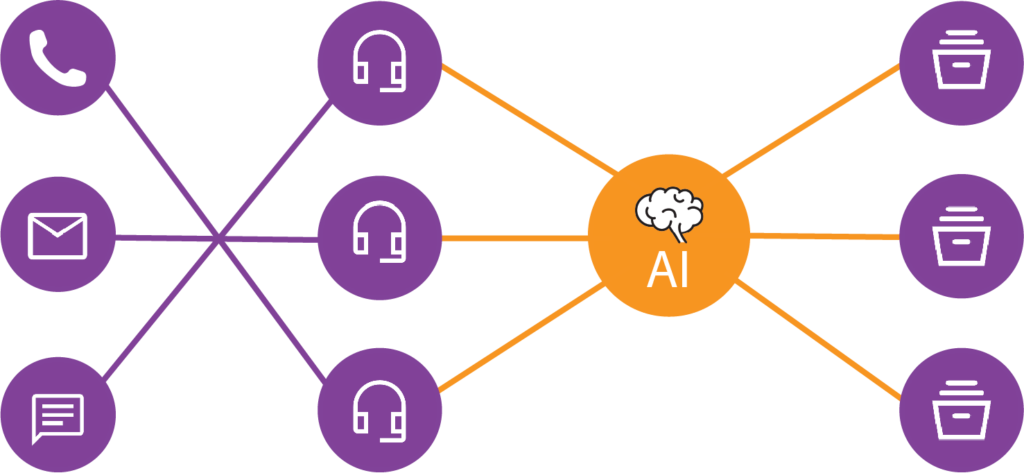
A resident calls about a parking permit. But is it a resident permit, a business permit, a visitor permit, or a change to the license plate number? For the resident, it’s a single question, while the employee must first determine which municipal term, information, and next step apply.
Experienced staff members often know these procedures by heart. New staff members, however, must simultaneously understand the question, find the correct information, and know which system to use. As a result, they spend more time searching, residents have to wait longer, and they’re more likely to ask an experienced colleague for help.
This is precisely where technology can help: not by taking over the conversation, but by guiding staff more quickly to the right information, follow-up question, and next step in the process.
For over 15 years, we’ve been building our own technology. We manage it ourselves and continue to develop it in-house. This means we aren’t dependent on foreign suppliers and can adapt quickly when your situation requires it.
Municipalities work with residents’ sensitive data every day. With Pegamento, that data stays in the Netherlands, is subject to Dutch law, and is fully GDPR-compliant. You always know who is managing your data.
Learn more about digital sovereignty →
We first work with you to determine what’s right for your organization—from strategy to implementation and ongoing support. We guide the rollout step by step and train your employees so your team can get up to speed from day one.
We’d love to show you how Agentic AI can help you in your business process.
At the Nijmegen Municipality’s KCC, the knowledge base—with over 600 articles—is the primary source of information when interacting with residents. Experienced staff members often know exactly which terms to use and where to look. For new employees, this is much more difficult.
During a walk-in session at the KCC department, it became clear what this means in practice. New employees spend more time searching for information, which means they put residents on hold more often and are quicker to turn to experienced colleagues for help. At the same time, much of the practical knowledge about search paths, systems, and processes resides precisely in the minds of those experienced staff members.
Together with the City of Nijmegen, we are therefore exploring the use of a Digital Assistant as a smart layer over the existing knowledge base. The knowledge base remains the definitive source of information, while the assistant helps employees clarify questions, find the right information, and follow important process steps.
First, we’ll examine how employees currently search for and use information when interacting with residents. Based on that, we’ll design support to help employees find the right information, follow-up questions, and next steps more quickly.
To do this, we can provide both a knowledge base and a digital assistant that helps employees find the right information more quickly. Does your municipality already use an existing knowledge base? If so, the digital assistant can integrate with it. This way, we build on what’s already in place and tailor the solution to your KCC’s needs.
If your organization does not yet have a suitable knowledge base, Pegamento can provide one. The Knowledge Base serves as the central source for validated information. This ensures that employees work from the same information and that it remains clear what an answer is based on.
The digital assistant helps employees quickly find the right municipal information based on a resident’s inquiry. It can also suggest relevant follow-up questions, enabling employees to clarify the inquiry more quickly and arrive at the correct answer.
Learn more about AI-driven intelligence →
The digital assistant can also guide employees through the process. This includes verifying information for a callback note, indicating which documents are needed for an appointment, or directing users to the correct system and the next step.
The digital assistant does not search the internet freely but uses only validated information from the connected knowledge base. Employees can see what an answer is based on and click through to the underlying article. This ensures that information remains verifiable and that the employee remains in control.
No. Pegamento can provide both the Knowledge Base and the digital assistant, but the AI layer can also be integrated with the municipality’s existing knowledge base. This allows the support system to integrate with the systems already in place within the organization.
No. The employee continues to lead the conversation, listen, and determine how the response is conveyed. The digital assistant provides support in the background by more quickly retrieving the right information, follow-up question, or next step in the process.



We’d be happy to help.
Schedule a 15-minute introductory meeting at
or call +31 (0)88 00 67 180
Deepen your knowledge with Pegamento’s white papers.