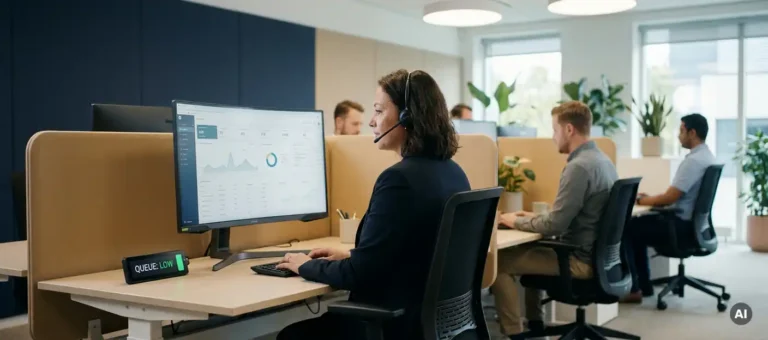
To get started with real-time customer feedback in a contact center, set up a brief, automated survey immediately after every customer interaction—such as an SMS survey, a rating question via email, or a voice prompt through the IVR system after the call ends. The key word is “immediately”: the shorter the time between the call and the feedback request, the more reliable the response. This applies to every contact center, regardless of size or industry. In this article, we answer the most frequently asked questions about how to set up an effective feedback loop, which measurement methods are best suited to your situation, and when you can expect to see the first results.
What specific benefits does real-time customer feedback provide to a contact center?
Real-time customer feedback provides a contact center with immediate actionable insights that allow you to quickly identify and resolve issues in the customer experience before they cause lasting damage. Instead of relying on delayed reports or annual customer satisfaction surveys, you gain daily insight into what’s actually happening on the front lines.
In practical terms, this means you can take action more quickly when individual employees or processes are underperforming, identify trends before they escalate, and provide management with up-to-date data on which to base decisions. A well-designed system for real-time customer feedback also enables the customer feedback analysis you need to demonstrate that improvements are actually having an impact. That is exactly the ROI justification that senior management and the management team are looking for.
An added benefit: customers feel heard. A simple feedback question immediately after a conversation conveys that their opinion matters, which in itself contributes positively to the customer experience.
Which feedback opportunities in a contact center are the most valuable?
The most valuable moments for gathering feedback are those that occur immediately after a customer interaction, when the experience is still fresh in the customer’s mind. For a contact center, these are typically the end of a phone call, the conclusion of a chat conversation, or the moment an email ticket is marked as resolved.
Not every moment carries the same weight. Prioritize feedback opportunities based on their impact:
- After a transfer: Customers who have been transferred have already gone out of their way. Their feedback reveals whether the internal routing is working properly.
- After a complaint or escalation: these are the moments when you have the most to gain or lose. Feedback here provides insight into the quality of the resolution.
- After an initial contact: first-contact resolution is one of the strongest predictors of customer satisfaction. Measure whether the problem was resolved on the first try.
- After self-service interactions: If a customer calls anyway after visiting the FAQ or using the chatbot, you’ll want to know why the self-service fell short.
By systematically measuring these moments, you build a customer feedback loop that not only tracks satisfaction but also uncovers the reasons behind it.
What measurement methods are suitable for real-time customer feedback?
The most appropriate metrics for measuring real-time customer feedback in a contact center are the Net Promoter Score (NPS), the Customer Satisfaction Score (CSAT), and the Customer Effort Score (CES). Each measures a different aspect of the customer experience, and they complement one another.
- CSAT (Customer Satisfaction Score): measures immediate satisfaction with a specific interaction. Ideal after every call or ticket. Easy for employees and customers to understand.
- CES (Customer Effort Score): measures how much effort a customer had to expend to get their issue resolved. Particularly relevant for contact centers where being transferred and having to repeat information are common sources of frustration.
- NPS (Net Promoter Score): measures overall loyalty and willingness to recommend. Less suitable as an immediate post-interaction metric, but valuable as a periodic benchmark.
For most contact centers, CSAT is the logical starting point for real-time measurement, supplemented by CES in situations where process frustration is a known pain point. The business analysis you conduct beforehand helps determine which method best suits your specific situation.
What tools do you need to get started with real-time feedback?
To get started with real-time customer feedback, you need at least three components: a trigger mechanism that sends the feedback request after an interaction, a channel through which the customer can respond, and a dashboard where the results are displayed centrally.
In practice, it looks like this:
- Trigger mechanism: This is often built into your contact center platform. After ending a call or closing a ticket, a feedback request is automatically sent.
- Feedback channel: Depending on your customer group, you can choose between text message, email, an IVR prompt immediately after the call, or a chat widget. Text messages and IVR typically yield the highest response rates because they require the least effort on the customer’s part.
- Central dashboard: This is where everything comes together. Without a centralized view of your customer feedback analysis, the data remains fragmented and unusable for decision-making.
A common mistake is using standalone tools that don’t communicate with each other. If your phone system, your CRM, and your feedback tool aren’t integrated, you’ll miss out on the context that makes feedback truly valuable. So when selecting tools, always look for contact center technology that supports native integrations.
How can you ensure that employees embrace customer feedback rather than fear it?
Employees embrace customer feedback when they understand that it is a tool for improvement and not a tool for evaluation that is used against them. The tone set by management when introducing a feedback system largely determines whether employees perceive it as an opportunity or a threat.
Practical steps that make a difference:
- Communicate the goal transparently: explain that feedback is intended to improve processes, not to evaluate individual performance. Also, actively share positive feedback with the team.
- Involve employees in the interpretation: organize short feedback sessions where the team reviews trends together. Employees who contribute ideas about causes and solutions feel a sense of ownership.
- Use feedback as a coaching tool: Team leaders who use feedback in one-on-one conversations as a starting point for development—not as evidence of failure—build trust.
- Celebrate improvements: when a change based on customer feedback leads to higher scores, make that visible. Employees who see the impact of their efforts become motivated.
A well-designed customer feedback loop works in both directions: customers provide input, and employees gain insights that help them grow. That’s what makes the system sustainable.
When do you start seeing the first results of a feedback system?
The first meaningful results from a real-time feedback system are typically visible within two to four weeks after going live, once there is enough response to identify patterns. Sustained improvements in customer satisfaction scores are realistic after two to three months, provided you actively act on the feedback.
The speed depends on three factors:
- Response Volume: The more customer interactions you handle each day, the faster you achieve statistical certainty. A large contact center handling hundreds of calls per day can generate meaningful data in as little as a week.
- Willingness to take action: A feedback system that only measures but doesn’t lead to adjustments won’t improve anything. The fastest results are seen in teams that discuss the data weekly and link concrete actions to the insights.
- Integration with processes: If feedback is immediately visible in a team leader’s dashboard and linked to specific calls or employees, you can take targeted action more quickly.
Don’t expect miracles in the first few weeks. Use that time to establish a baseline: what are the current scores, which questions generate the most complaints, and where is there the most variation among employees? That baseline measurement is the foundation for everything that comes next.
How Pegamento Helps Set Up Real-Time Customer Feedback
At Pegamento, we understand that setting up an effective feedback loop requires more than just purchasing a tool. It involves proper integration between your phone system, your CRM, and your reporting environment, combined with an approach tailored to your organization and customer base.
What we offer:
- Integrated contact center solutions with built-in feedback measurement, without separate systems that don’t communicate with each other
- Centralized dashboards that combine real-time customer feedback analysis with operational data such as call duration, first-contact resolution, and channel selection
- Support in setting up feedback opportunities that align with your customer journey, from IVR surveys to automated SMS and email surveys
- Customized solutions using standard building blocks, so you can get started quickly without costly, lengthy implementation processes
- Everything under one roof: from technical implementation to employee training and reporting for management
Pegamento is ISO 27001-certified (information security), supplemented by ISO 9001 and ISO 26000, so you can trust that customer data is processed securely and responsibly. Ready to get started? Contact us, and together we’ll determine which approach best suits your contact center.
Frequently Asked Questions
What is a realistic response rate for real-time feedback surveys in a contact center?
A realistic response rate depends heavily on the chosen channel. IVR surveys conducted immediately after a call typically achieve a 15–30% response rate, while SMS surveys yield 10–25% and email surveys often remain below 10%. You can increase the response rate by keeping the survey as short as possible (one to two questions), sending the request within five minutes of the call, and making the tone personal and relevant. A low response rate doesn’t have to be a problem, as long as the sample size is large enough to identify reliable patterns.
What should you do if customers consistently give low scores but don’t provide any explanation?
If customers consistently give low scores without providing open-ended comments, that in itself is a signal: the barrier to giving feedback is too high, or the question isn’t inviting an explanation. Add one optional open-ended question, such as ‘What could have been better?’, and make it clear that a response is not required. In addition, analyze the low scores in combination with operational data such as call duration, transfers, and channel selection to identify causes without requiring the customer to specify them.
How do you prevent customers from experiencing survey fatigue when they contact you regularly?
Survey fatigue occurs when the same customer receives a feedback request with every interaction. Set up a suppression rule so that after completing a survey, a customer does not receive a new request for at least 30 to 60 days, regardless of the number of interactions during that period. Most modern contact center platforms and feedback tools support this through CRM integration. This way, you protect both the customer relationship and the quality of your data.
Can you also use real-time customer feedback if your contact center works with external or contracted agents?
Yes, real-time customer feedback is especially valuable when working with external or contracted agents, because it allows you to monitor how customers experience the service independently of the vendor. Just make sure the feedback trigger runs on your own platform and isn’t dependent on the external party’s systems, so you retain control over the data. Also use the scores as an objective component of the SLA evaluation with your vendor.
What common mistakes should you avoid when setting up a feedback system?
The three most common mistakes are: asking too many questions, which lowers the response rate; collecting feedback without having an internal process to actually act on it; and launching the system without informing employees in advance about its purpose and how it works. A fourth pitfall is measuring without a baseline: if you don’t know your starting score, you can’t demonstrate improvement. Start simple, measure consistently, and expand the system step by step.
Is real-time customer feedback also suitable for small contact centers with fewer than ten employees?
Absolutely. Feedback has a direct impact, especially in small contact centers, because the gap between data and decision-making is small. Volume is a point to consider, though: with fewer calls per day, it takes longer to see statistically reliable patterns. Compensate for this by starting with a single simple CSAT question via text message or email, and evaluate the results monthly instead of weekly. Even ten to fifteen completed surveys per week can already provide useful insights.
How do you link customer feedback to individual employees without creating a culture of blame?
Link feedback to employees only at the aggregated level in team overviews, and use individual scores exclusively in one-on-one coaching sessions—never in public rankings or bonus calculations. Ensure that team leaders are trained to discuss feedback as a development tool, using questions such as ‘What do you think is the cause?’ instead of ‘Why did you score lower than your colleague?’ A culture of psychological safety is the prerequisite for feedback to actually lead to improvement.