
What data do you need for omnichannel personalization?
For effective omnichannel personalization, you need a strategic combination of demographic data, real-time behavioral data, transaction history, preference data and interaction data. These data types must be integrated from all customer touchpoints to create a complete customer profile. Without this structured data approach, personalization remains superficial and organizations miss opportunities for meaningful customer engagement. Omnichannel personalization is the delivery of consistent, tailored customer experiences across all communication channels, based on a unified customer dataset. It differs fundamentally from single-channel personalization in that it synchronizes customer behavior and preferences across telephony, email, WhatsApp, live chat, social media and other digital channels. Traditional data approaches are inadequate because they create fragmented customer profiles. […]
How do you analyze omnichannel customer behavior?
Analyzing omnichannel customer behavior means understanding how customers use different channels during their buying journey. You collect data from all touch points such as website, phone, social media and physical locations to discover patterns. This gives you insight into customer preferences, bottlenecks and opportunities for better service. With the right tools and approach, you transform this data into concrete improvements for your customer experience. Omnichannel customer behavior describes how customers move seamlessly between different channels as they interact with your business. The difference with multichannel is that with omnichannel, all channels are connected and customers can continue their journey where they left off […].
How do you measure the success of RPA?
You measure the success of RPA through a combination of hard numbers and soft indicators that together give the complete picture. The key metrics are process efficiency (such as lead time reduction and error reduction), cost savings per process, and employee satisfaction. ROI is calculated by plotting direct cost savings and indirect benefits against implementation costs, with payback periods typically between 6-18 months. Key KPIs for RPA success include process efficiency metrics such as lead time reduction (often 50-80%), error reduction rates, cost savings per process, and employee satisfaction. These indicators give you direct insight into the value automation adds to your organization. When measuring RPA performance, you look at […]
What benefits does RPA offer businesses?
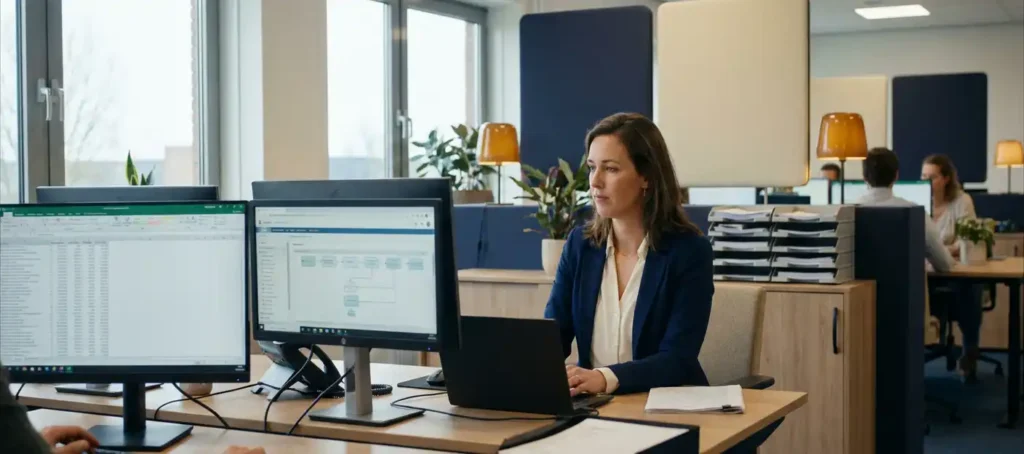
RPA (Robotic Process Automation) offers businesses significant benefits by automating repetitive tasks with software robots. Key benefits include cost savings of up to 80%, increased process accuracy, 24/7 availability, improved employee satisfaction and better compliance. Companies often see measurable results within 3-6 months, with employees able to focus on more valuable tasks while robots take over routine work. RPA stands for Robotic Process Automation – software robots that perform repetitive, rule-based tasks as human employees would. These digital assistants work with existing systems through the user interface, without requiring you to replace costly IT infrastructure. They follow predefined rules to perform tasks […]
How is omnichannel different from single channel?

The difference between omnichannel and single channel is in how your customers can communicate with your organization. With single channel, you use one communication channel, such as phone only or email only. Omnichannel, on the other hand, integrates all channels – phone, email, chat, WhatsApp and social media – into one seamless experience. This means customers can switch between channels without having to repeat information, while as an organization you always have the complete picture of every customer interaction. Single channel communication means that your customers contact you through one specific channel – for example, by phone only or by email only. With omnichannel, […]
What are the benefits of omnichannel?
Omnichannel offers organizations an integrated approach where all customer contact channels work seamlessly together in one system. This ensures consistent customer experience, increased employee efficiency and measurable cost savings through better process integration. Key benefits include improved customer experience through centralized information, operational efficiency through automated workflows, and demonstrable ROI through lower costs and higher customer retention. Omnichannel is an integrated communication strategy where all customer contact channels – telephony, e-mail, WhatsApp, chat and social media – work together through a single platform. Unlike multichannel, where channels operate separately, omnichannel shares real-time customer information between all touchpoints. This means customers can seamlessly switch between channels without losing information. It […]
How does an omnichannel strategy work?
An omnichannel strategy works by seamlessly connecting all of your company’s communication channels so that customers have a consistent experience no matter how they contact you. Instead of separate channels that don’t talk to each other, create one integrated system where information is automatically shared between phone, email, chat, social media and other touch points. This means customers never have to repeat their story and your team always has the full context of previous interactions. An omnichannel strategy is an integrated approach where all of your organization’s communication channels function as one. Customers can switch seamlessly between channels without […]
Can RPA help with digital transformation?
Yes, RPA can greatly accelerate your digital transformation. It makes your organization more agile by automating repetitive tasks without having to replace entire systems. RPA acts as a bridge between your existing software and modern digital solutions, allowing you to transform step by step. This article answers key questions about how RPA supports your digital transformation. RPA (Robotic Process Automation) is technology in which software robots mimic human actions in digital systems. These robots can click, type, copy data and fill out forms just as an employee would. The big difference is that they can do this 24/7 […]
How do you implement an omnichannel approach?
Implementing an omnichannel approach means making all of your organization’s communication channels work together seamlessly so that customers have a consistent experience no matter how they contact you. This goes beyond multichannel, where channels operate independently of each other. With omnichannel, all channels share the same customer information and history, so customers never have to repeat their story. Implementation requires a thoughtful strategy where technology, processes and people come together for a unified customer experience. An omnichannel approach is an integrated strategy where all of your organization’s communication channels – telephony, e-mail, chat, social media and other touch points – work together seamlessly through one […]
What is omnichannel?
Omnichannel is an integrated communication strategy where all customer contact channels work together seamlessly within a single system. Your customers can move from phone to chat, to email or social media without losing information or having to repeat their story. This is made possible by central customer data and technical integration that connects all channels into one consistent experience. Omnichannel means that all your customer communication channels are fully integrated and function as one. Instead of separate channels coexisting, telephony, email, chat, social media and other touch points work together through one central system. This ensures that customer information, call history and context are always […].