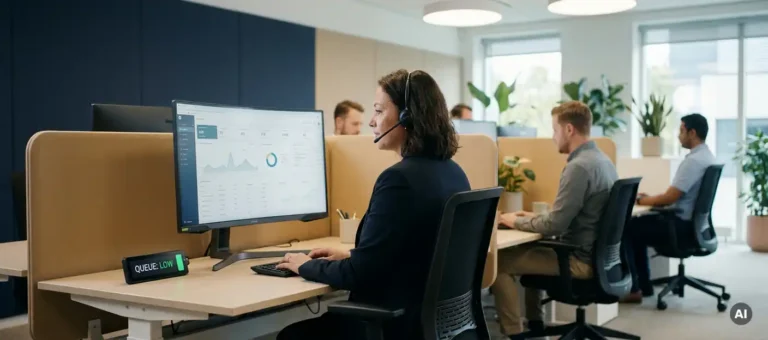
Visual support from the customer contact center. Or: from “I hear what you say” to “I see what you mean. The Video Assistant is on the rise.
”Customer contact employees now sometimes feel like they are calling with a blindfold on,” explains Joost Dijkhuis of Pegamento. Dijkhuis came up with the Video Assistant. Pegamento is a digital service provider that provides smart customer contact solutions to companies. ”A customer explains what kind of central heating boiler he has or which lights on the Internet router are and are not on, but often a verbal description creates noise on the line. The Video Assistant can prevent that. The customer service representative can then explain that the water pressure is too low and how it needs to be adjusted, or how someone can reset their router.”
Using video for customer contact is not new, of course, but there are thus many more applications than people often think. ”During corona we saw that more and more companies were starting to use video calling, for example for a mortgage call or other advice,” says Dijkhuis. ”But with a Video Assistant you can do much more, without the disadvantages of classic video calling.”
That way, you don’t have to use the Video Assistant from Pegamento does not require calling from a phone number and the customer service representative himself does not appear on screen, as with FaceTime and Whatsapp, for example. Also, customers do not need a separate app for the Video Assistant.
Intuitive and functional
So how does it work? If video contact proves necessary during a phone or chat conversation, the customer service representative can send a text message to the customer. ”That all works very intuitively for the employees,” Dijkhuis explains. ”If the recipients then click on a link and agree to camera access, a screen opens and the employee can see where the camera is pointed. That employee can then, for example, take a picture of the situation and send it back to the user with some illustrations, arrows and/or text.”
There are numerous conceivable applications for the Video Assistant. For example, housing corporations can use it to get a first impression of a tenant’s situation. ”That way, expensive technicians don’t have to go to a house first to see what’s going on; they can make do with one less visit. Moreover, after such a visual peek, they can also immediately see what they need to take away. That saves a lot of miles,” Dijkhuis explains.
Employees of insurance companies can also use the Video Assistant, for example to get an initial estimate of a claim. ”In the case of transport damage, but also damage in the home, the insurer is quickly contacted. They can use the Video Assistant to see immediately what has happened.”
Higher satisfaction
And perhaps most importantly, both customer and employee satisfaction go up. The Video Assistant is a simple and functional tool that directly improves mutual understanding,” says Dijkhuis. We see that the number of first-time fixes goes up, that the conversations are shorter and that you end up having to solve something on location less often. So it’s a sustainable solution, too. Just last week someone said to me: if I had had that Video Assistant, I wouldn’t have had to drive from Zeist to Groningen the other day for nothing.”
This interview was co-sponsored by the Customer Service Federation.
Free: Give your customer service eyes
Want to learn more about the Video Assistant? Read all about it in the free whitepaper