
As an organization, you want to keep up with the times and make sure that you are accessible to both your customers and other important stakeholders, such as parties you work with. Change happens very quickly these days. What is successful today may be useless tomorrow. Now is the time for the expectation of best service and personal contact. Customers are even willing to spend more to get those. Customer expectations are constantly changing. As an organization, how can you keep up with them? We have gathered 5 trends for you in an infographic to keep up with the crucial developments of customer contact.
Trend 1 – Hybrid working
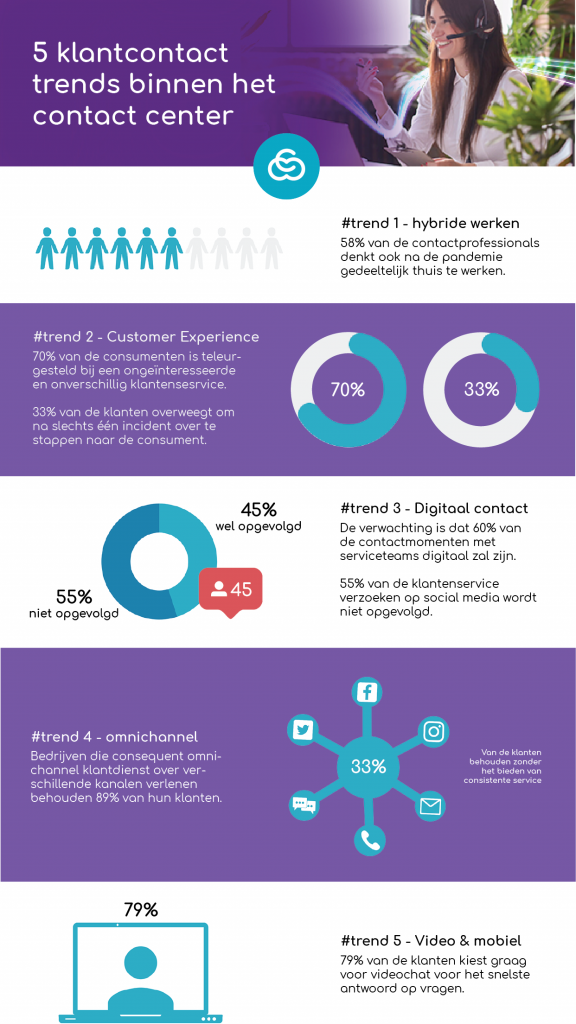
Hybrid working is the new normal. Many companies are joining in, as are contact centers. A study by TNO and others shows that the Dutch want to continue working from home at least one day a week even after the pandemic. An industry study shows that 58% of contact professionals are thinking of continuing to work partially from home even after the pandemic. And that means that your contact center will no longer be in one location, but spread out.
This can pose a problem for your organization’s reachability, because who will answer the office phone if everyone decides to work from home? Or how can a customer service representative ask that one question of that one customer to his colleague when he is not in the office? Or how to make sure that queues on the phone don’t get too long because there are only a limited number of colleagues available to answer them. And how do you prevent the customer from subsequently being told on the phone: ‘The waiting time is about 15 minutes’ or ‘there are 5 more waiting for you’. Recognizable?
What if this could be done more efficiently. For example, by transferring calls that come into the office to employees at home. Read more about it in our blog: 3 tips for optimal customer contact within your customer service.
Trend 2 – Customer Experience
You probably hear it on all sides, but there’s no getting around it: Customer Experience is becoming the new business strategy. Indeed, Customer Experience has become more important in recent years. COVID-19 has contributed to this, because personal contact in times of crisis is important. Social need is not included as the third step in Maslow’s pyramid for nothing.
From the research report by Zendesk found that 75% of customers are willing to spend more with companies that offer a good customer experience. According to the Steam Connect trend report, 70% of consumers are disappointed with uninterested and indifferent customer service. 33% of customers even consider switching to a competitor after just one incident.
Perhaps you yourself have had an experience with a customer service that did not serve you well. My experience is with a mail delivery service. I had ordered a package from a store. I had this one delivered to my home. The store’s website said: ordered today before 11 p.m. is delivered the next day. Let’s just say I had ordered well before 11:00 pm. You can guess, the package wasn’t there the next day, but it was ready at the delivery service. I chose to call the delivery service’s customer service and ask about the status of my package. After a friendly conversation with a lady, she promised me on the phone that it would actually be in the house the next day. To my disappointment, this was not the case.
For me, this was a lesser experience that I will remember better than a positive experience. Psychologists call this phenomenon the “negativity bias. Negative experiences affect us much more than positive ones.
Trend 3 – Digital contact
Because of the pandemic, face-to-face contact was difficult. As a result, we started contacting customer service digitally, among other things. Consider, for example, the questions that come in via Facebook Messenger, WhatsApp, live chat or Instagram’s DM. Gartner predicts that 60% of contact moments will be digital by 2023.
What stands out is that 55% of customer service requests via social media are not followed up. That would mean that 45% of your (potential) customers are getting answers to the question they ask. Has this happened to you before? Do you recognize the frustrating feeling of having to chase your answer all over again as a customer? You would do well to include different digital channels in your customer contact omnichannel strategy, provided you make sure everyone is helped. To keep an overview of incoming requests, Pegamento Contact Center is the solution. Namely, letting messages come in and communicate them from one platform.
Trend 4 – Omnichannel
Trend 3 ties in nicely with the next trend, which is that customers want to contact your organization through more and more avenues. Customers today expect companies to provide service on the channel customers prefer. In addition, experts expect customer experience to become more important than product and price. So basically, you need to offer a seamless customer journey to your customers. Going back to your own experience for a moment. How do you like to be helped quickly? Without an organization sending you from case to case? Fine, right? This actually makes us more likely to choose the one organization that helped us so well.
To ensure the optimal customer journey during customer contact, channels must merge flawlessly. Customers must also be able to continuously switch channels without having a different experience. To achieve this, omnichannel customer service must be delivered consistently. A study shows that companies that consistently provide omnichannel customer service across channels retain 89% of their customers. Companies that do not do so retain only 33% of customers.
Trend 5 – Video
The pandemic is responsible for promoting a range of customer contact trends. So was video. Physical contact was naturally reduced and working from home was a thing. Instead of physical face-to-face contact, in addition to digital channels, we started doing it via video calls. Companies are not just using video calls for internal meetings with colleagues and partners – they are also video calling customers much more professionally. Customers have found that video calling is the fastest way to get their questions answered. Faster than other contact channels. 79% of customers therefore prefer to choose video chat. It creates more trust and a more personal connection between organization and customer.
Video allows companies to leverage technology without losing the human touch. Screensharing is an emerging method for video-based customer service. This involves the agent taking over the screen on the customer’s device to solve a problem. It is now even possible to watch a problem through the customer’s camera, as with Video Assistant.
For example, a customer’s central heating boiler has a malfunction. Sometimes it is difficult to find out the problem and its cause over the phone or via chat. There is noise on the line because the employee has to decipher what the customer describes verbally. If customer service can watch along via the customer’s on-site camera, the service employee can immediately see the type of central heating boiler and the problem. The problem can be solved efficiently and completely. It saves travel time, service time and unnecessary visits.
The customer contact trends in PDF? And get access to more tips!
Download PDF the 5 customer contact trends within the contact center for free and get access to tips on how to capitalize on the trends. Also easy to share with your colleagues.
Is your customer service already ready to go for 2022?