Between man and machine

On April 15, 2026, Lisanne Buik stood before a room full of professionals at the Spoorwegmuseum in Utrecht during an event organized by Pegamento. It could have been a keynote like so many given on artificial intelligence: full of charts, future scenarios, tools, models and warnings about what organizations should not miss above all else. But Buik chose a different entrance. Her talk was not primarily about technology. It was about people.
About what happens when technological advances move so fast that organizations barely take time to pause to consider the direction. About how to keep AI under control not only with rules and oversight, but especially how to avoid building the wrong things. And about an uncomfortable but necessary thought: that the most important AI question today may not be what the machine can do, but what humans still want to do.
That made her keynote in Utrecht more than a technical speech. It became a story about the tension of our time: between speed and reflection, between efficiency and humanity, between automation and responsibility.
A room full of curiosity and, under the skin, also unease
The appeal of AI is huge. Organizations want to keep up, employees want to understand what is changing, executives are looking for opportunities without losing their grip. That mix of curiosity and nervousness also hung over the meeting at the Railway Museum. Not as overt panic, but as a recognizable feeling that lives under the surface in many organizations.
Belly gave words to that. She outlined how overwhelming the AI pace has now become. New models follow each other in rapid succession. New tools appear almost daily. Possibilities are piling up, while ethical questions are growing at least as fast. It asks a lot of people to not only keep track of all that, but to translate it immediately into policies, processes and concrete choices.
That sense of overwhelm was not an afterthought in her story, but an important starting point. Because precisely when organizations allow themselves to be rushed, there is a risk that reflection is traded for implementation. Then the question “how quickly can we deploy this?” wins out over the question “why are we actually doing this and for whom?”
Not more control after the fact, but better questions beforehand
At its core, Buik’s keynote revolved around a simple but fundamental shift in thinking. Many discussions about AI involve regulation, compliance and oversight. That makes sense, because where new technology appears, regulations sooner or later follow. But according to Buik, the larger task lies more in the process.
Not just checking what has already been built, but asking better questions before then.
This may sound obvious, but in practice the opposite often happens. Organizations experiment, roll out tools, link systems to existing processes and then try to hedge the risks. Ethics and governance then follow implementation, whereas, according to Buik, they should already be embedded in the design.
That thought gave her keynote a different tone than the usual AI stories. She spoke not from doomsday thinking, but from design thinking. Not from the idea that technology should be slowed down, but from the belief that progress is only truly valuable when it is consciously designed.
From Deep Blue to ChatGPT: a history of wonder and discomfort
To show that these questions are not out of the blue, Buik placed the current AI wave in a broader historical context. She referred to the 1997 moment when chess champion Garry Kasparov lost to IBM’s Deep Blue, a symbolic tipping point that showed a machine could outperform a human in a specific domain.

She says what makes those images still so fascinating is not only the race itself, but especially the reaction of the people around it. The disbelief. The confusion. The quiet question that was already there: if the computer can do this, what does that mean for us?
That same question returned, in much broader form, with the emergence of generative AI. The moment when ChatGPT made visible to many people that AI was no longer an abstract field of research, but a practical, accessible technology. Suddenly anyone could write, summarize, brainstorm, translate, analyze with it. Not perfect, but good enough to noticeably change work processes.
According to Buik, that’s where the real acceleration began for many organizations. Not only technologically, but also culturally. Because from then on, AI no longer became a topic for a small team of experts, but a factor in virtually every conversation about work, customer contact, innovation and competitiveness.
What 4 changes is AI bringing about and what is the impact
One of the strongest lines in the keynote was Buik’s explanation of four major shifts she believes lie beneath the current AI wave. Those developments made her story concrete and helped explain why the topic is now having such an impact.
The first change: AI goes from anywhere to everywhere.
Where many people still associate AI with a chat window or a smart assistant on a screen, Belly sees the technology spreading at lightning speed to all kinds of forms and interfaces. Not just in software, but in glasses, microphones, voice-activated applications and apps that are ever closer to everyday life.
That means AI is no longer something you actively go to. It’s increasingly coming to you. It listens in, helps out, thinks with you, organizes with you. For users, that can be convenient. But it also makes the technology more intrusive. Once AI gets closer to conversations, choices and relationships, questions of privacy, transparency and human boundaries become much more tangible.
Therein lay the very tension that Belly made palpable. Not only: what can this technology do? But also: what does it do to our way of living, working and interacting with each other?
From occasional use to a system that always works through
The second change Belly described is that AI goes from sometimes to always.
People need rest. Organizations have working hours, meeting structures and trade-offs. AI systems know none of that. They can basically work continuously, picking up tasks, going through steps and executing processes, even when no one is watching. That makes many applications attractive: generate reports, analyze data, speed up workflows, take over repetitive work.
But according to Buik, this also changes the nature of risk. It is no longer just about a loose prompt or a one-time output, but about systems that can act increasingly independently within a process. That requires new forms of delimitation. How much freedom does such a system get? What decisions is it allowed to make for itself? When should a human be able to intervene? And who is responsible when things go wrong?
These are questions that have not yet been adequately worked out in many organizations, precisely because the temptation is to look primarily at productivity gains. But the greater the autonomy of a system, the more important become the design choices that precede it.
The physical world also enters the picture
The third change Buik mentioned was the movement of AI from digital to physical. Robotics, she said, is no longer a distant future, especially in industrial environments. As locomotion, sensor technology and AI control become more sophisticated, the impact of artificial intelligence will become increasingly visible beyond the screen.

That prospect immediately evokes a different kind of response. Not only questions of efficiency, but also of proximity, acceptance and loss. What happens when tasks in the physical world disappear? How does it feel when robots are not just in factories, but eventually appear in households or care environments? Which forms of human presence are replaceable and which are not?
Belly treated those questions not as science fiction, but as serious foreshadowing of a debate that has yet to be fully engaged. Precisely because technology is becoming more concrete, human reaction to it is also becoming more concrete.
Everyone becomes a maker, which is at once hopeful and risky
The fourth change touched on something very recognizable to many organizations: AI is going from someone to everyone.
Whereas programming was long the domain of specialists, now many more people can use AI to build, automate and combine applications. That opens doors. Non-technical professionals can try out ideas and improve processes faster. The distance between idea and implementation is shrinking.
Belly also saw something hopeful in this: creativity and initiative are becoming more widely accessible. But at the same time, this development makes organizations vulnerable. Because as soon as many more people can build something, the risk also arises that applications go live without sufficient security, testing or reflection.
This is one of the paradoxes of our time. AI democratizes innovation but makes governance more difficult. Precisely as technology becomes more accessible, the need to formulate clear values and frameworks increases.
Behind technology is a human-centered view
Perhaps the most layered part of Buik’s keynote was the philosophical middle section. There she posed the question of what actually lies beneath our dealings with AI. For those who talk about efficiency, replacement and optimization are ultimately talking about humans, although that is not always said out loud.
Belly contrasted two worldviews.
In the first worldview, humans are essentially biological machines: smart, complex, but ultimately explainable and optimizable. From that view, it makes sense to see AI as something that can take over human tasks once it is sufficiently powerful. The machine then becomes the competitor. Humans are still temporarily needed, but not fundamentally indispensable.
In contrast, she placed a more relational view of man, which she linked to the philosophy of Ubuntu: I exist in relation to others. In it, man is not just an accounting unit or means of production, but a social, moral and creative being. Someone who derives meaning from context, cooperation, judgment and connection.
That difference is more than an intellectual nuance. According to Buik, it determines how organizations design AI. Those who view humans as expendable will use technology differently than those who view humans as moral and relational anchors. With that, her keynote also became a call to be honest about the assumptions behind AI strategy.
What organizations often discover too late
A major part of the story revolved around examples of situations where AI or algorithmic systems derailed. Not to shock, but to show how often the root of the problem can be traced back to questions asked too late.
Among other things, Belly mentioned a chatbot that was developed to guide people with eating disorders, but in practice gave advice that actually turned out to be harmful. What went wrong there was not only a technical error, but also a design choice. Apparently, not enough thought had been given to what “helpful” means in a vulnerable context.
Examples of discrimination, exclusion and lack of control also came up. In such cases, AI does not work neutrally. It reinforces assumptions, reproduces patterns and can legitimize decisions that have major consequences for those involved. Moreover, if no one intervenes in time, damage can accumulate.
Those examples showed that ethics in AI is not something abstract for policy notes or conference rooms. It’s about real people, real mistakes and real consequences. About customers being unfairly excluded. About citizens being misjudged. About employees who have to do their jobs differently without being clear what their new role still is.
The question that changes everything: replace or support?
Beneath many examples from the keynote lay one recurring tension: is AI meant to replace humans or support them?
Belly made this tangible with the example of organizations that first embrace AI as a means of making large groups of employees redundant, only to discover later that human quality cannot simply be captured in a system. In customer contact, decision making and guidance, it often turns out precisely that nuance, context and empathy do not easily disappear from the process without also reducing quality.
In doing so, she did not advocate romanticizing human labor or rejecting automation. She did, however, call for focus. Because if you don’t explicitly establish what role humans keep, you run the risk that efficiency logic will automatically dominate. Then substitution creeps into the process without a mature discussion.
According to Buik, humans should remain “in the lead” where judgment, responsibility and relational consideration are essential. Not because machines can do nothing, but because not everything that matters can be captured in output or speed.
From compliance to ethics as a design force
During her keynote, Buik also elaborated on a growth path for organizations. That made her story practical and relevant to the attendees in Utrecht, many of whom are working on digitalization, customer contact, service delivery and innovation.
At the very bottom of that path is the phase she characterized as the wild west: tools are introduced ad hoc, experiments follow one another, speed is more important than reflection. Next comes the compliance phase, in which organizations rig up policies, rules and basic controls to comply with laws and regulations.
But according to Buik, that is not yet the end point. The next step is strategic maturity: AI is then not just allowed or limited, but deliberately designed for scalability, auditability and consistency. Only after that comes the stage it really wants to get to: ethical by design.
In that approach, values are no longer an after-the-fact correction, but a design principle. You don’t ask only after going live whether something is fair, responsible or people-centered. You include those questions from the first design choices.
That idea dovetailed directly with the collaboration she mentioned with Pegamento. This involved the ambition to make AI more mature not only technically and legally, but also organizationally and ethically.
A framework that starts with the right questions
To that end, Buik presented a framework with five central perspectives: generativity, resonance, agency, connectivity and embodiment. Behind those terms is an attempt to get organizations to think systematically about the human-AI relationship.
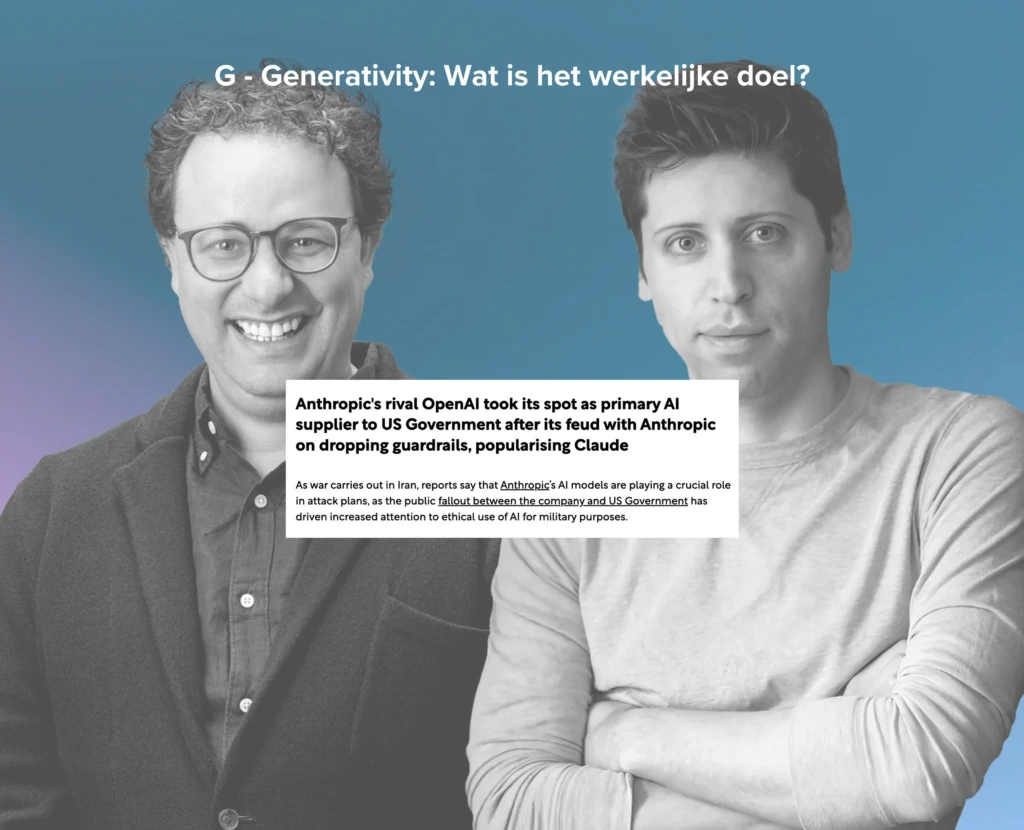
Generativity revolves around the question of what purpose an application actually serves and what value it creates in the longer term. Is it just a tool for quick profit, or does it actually contribute to better service, better collaboration or a healthier organization?
Resonance is about connecting with the user. Does the application fit the lifeworld of the people who interact with it? Does the system work fairly and meaningfully for different groups, or does it favor certain types of users while disadvantaging others?
Agency is all about direction. How much control does the human maintain? When does human intervention remain necessary? And where is the line between support and replacement?
Connectivity looks at collaboration and connection. Does technology enhance human relationships, accessibility and contact? Or, on the contrary, does it create distance, exclusion or new silos?
Finally, embodiment is about evaluation, learning and ongoing development. Is there structural monitoring? Is there active learning from mistakes? And does a system keep moving, or is it left to its own devices after being commissioned?
What made Buik’s approach strong was that she presented these questions not as theoretical models, but as tools for real design decisions. Ethics thus became less vague and more workable.
A moment of silence in a story about speed
Perhaps the most human moment of the keynote came when Buik asked the audience to close their eyes for a moment. Not a theatrical gesture, but a brief invitation to reflection. After all the examples and future scenarios, what lingers as something that really matters? What concern, discomfort or blind spot still gets too little attention in your own organization?

It was a small moment, but significant. Right in a story about technology, speed and design, she made room for slowing down. As if to show that dealing with AI maturely begins not only with knowledge, but also with attention. With a willingness not to immediately push away discomfort, but to take it seriously.
That moment matched the broader undertone of her keynote. This was not about inhibiting innovation out of fear, but about reclaiming moral space at a time when technological logic often threatens to dominate everything.
A hopeful story precisely because it is not naive
Remarkably, Belly did not end on a somber note. Although her keynote was full of risks, dilemmas and wrongs, the tone was not cynical. Instead, she outlined a future in which AI can bring much good, provided people don’t let go of leadership.
She talked about opportunities to redesign work, make education more personal, enhance creativity and accelerate innovations that contribute to a more sustainable and richer society. Not as a fixed vision of the future, but as a direction. An opportunity that will only become reality if organizations are willing to ask tough questions, draw boundaries and take values seriously.
That gave her story something human and believable. Not blind optimism, but a hope born of responsibility. Not: AI will solve it. But: we can make something good out of it, if we design it consciously.
What lingers from this keynote
Lisanne Buik’s keynote on April 15, 2026 at the Railway Museum in Utrecht was thus essentially a plea for maturity. Not technological maturity in the sense of more implementations, more tools or more automation, but moral and organizational maturity.
Her story made it clear that the AI question of our time is not just about innovation, but about direction. About leadership. About the relationship between man and machine. About the courage to ask not only what is possible, but also what is desirable.
That may be exactly why her story stuck. Because in the midst of all the speed, it brought back a simple but urgent principle: technology earns trust only when people are willing to ask the right questions up front.
And perhaps that, on that April afternoon in Utrecht, was the most valuable message of all. Not that the future is already fixed, but that it can still be designed, as long as man does not forget that he himself should still be at the helm.
Pegamento and the GRACE framework
Pegamento sees the GRACE framework as a valuable route to mature AI use. Not as a theoretical model, but as a practical compass for organizations that want to deploy AI without losing sight of the human touch. By embracing this approach, Pegamento underscores that responsible AI use begins with design, leadership and the right questions up front.
Wondering how this framework works in practice and what it can do for your organization? Then contact Pegamento for an in-depth conversation about ethical and strategic AI design.
Also interesting to read is the blog on Ethical considerations for deploying Agentic AI.