Never before has this been the extra eye within each sector
Chances are you already use image recognition. Consider, for example, facial recognition on smartphones to unlock your phone. Or simply scanning a QR code with your mobile’s camera. You see this kind of technology popping up more and more. Especially in recent years it has made great leaps. And the possibilities and applications keep evolving within all kinds of sectors. What do you think, are the possibilities endless?
Multi-level insights with image recognition
Just a quick note on what exactly it is. Image recognition is interpreting useful data from pixels of, for example, photographs or videos. If you then use this data to automatically take action then you are talking about computer vision. Computer vision is an area of artificial intelligence that trains computers to interpret and understand the visual world. Using digital images from cameras and videos and deep learning models (a computer training to perform human tasks), machines can accurately identify and classify objects and then respond to what they “see.
The rules “what” they should “see” can be defined by a programmer. But using artificial intelligence, it is also possible to generate this. In this case, using a data set, you train a neural network capable of recognizing specific objects or patterns. Based on this, the system can pass signals for action to be taken or, on the contrary, perform this automatically.
One familiar to us is Amstelveld bakery. The first bakery in the Netherlands to use a system with a camera and AI networks to check bread for quality. The system learned through AI to recognize the tastiest buns fully automatically and take the ones that don’t fit off the belt.
The extra eye in different sectors
With the increased computing power of computers, you see image recognition in more and more places. Even in sectors where you don’t expect it. We take you through examples that we have already realized within different sectors, so that you get an idea of what is possible.
Health and medical
The applications of computer vision within the health sector capture and analyze a large amount of data in a medical examination. An example is monitoring vitamin D in patients. The smart camera measures vitamin D intensity from a Lateral Flow Indicator through a control dash. The software automatically stores the results without human estimation.
Agriculture and animal welfare
The breeding, keeping and use of animals in our agriculture places high demands on their health and welfare. Cameras, linked to a digital system, monitor the animals. This system detects abnormalities and checks the animals for signs of disease, wounds or other physical discomfort.
Infrastructure
Nowadays it is possible to calibrate normal cameras so that they work together, creating a 3D overview of the traffic situation and what is there. A real-time overview of all objects, people and (motor) vehicles participating in traffic is created. What you can do with it? Track road surface wear, see bottlenecks for dangerous traffic situations and perform other checks. Cameras can also be applied to bridges to ensure safety during their crossing. An example of such a camera would be Our BCR system that we developed for the Department of Public Works.
Industry & Logistics
No more searching the database. Smart cameras match a (printed) product to the original order and print it out. This saves manually checking all barcodes and orders.
Inventory management is also one of the possibilities. Cameras above cabinets and boxes in a warehouse keep track of how much of something is left. Has it run out? Then comes a notification to purchase it. In addition to inventory management, it is possible to apply calibrated cameras, like infrastructure, to ensure safety in warehouses.
Until recently, visual inspection of products was a labor-intensive activity. Computer vision makes it possible to automate quality recognition. Cameras constantly monitor products on the assembly line and reject deviating products. But even the painting of a residential area is automatically checked by a camera on a drone.
Image recognition in retail
There are also applications within retail. Conceived several years ago, but certainly a good example is Zalando’s Fashion Finder. Do you see someone walking down the street wearing the coat of your dreams? Then simply take a picture of that and the app will look for a garment that resembles the picture.
Another example is a 3D foot scan using a smartphone’s camera. With the camera in an app you scan around your foot, after which an overview of your feet emerges with data such as length, width, instep height and heel thickness. That way you can see which shoes fit your feet and always order a pair online that fit well.
Read more about applications of image recognition on a smartphone here: a driving fish through image recognition on a smartphone with 5G.
So also applicable within my sector?
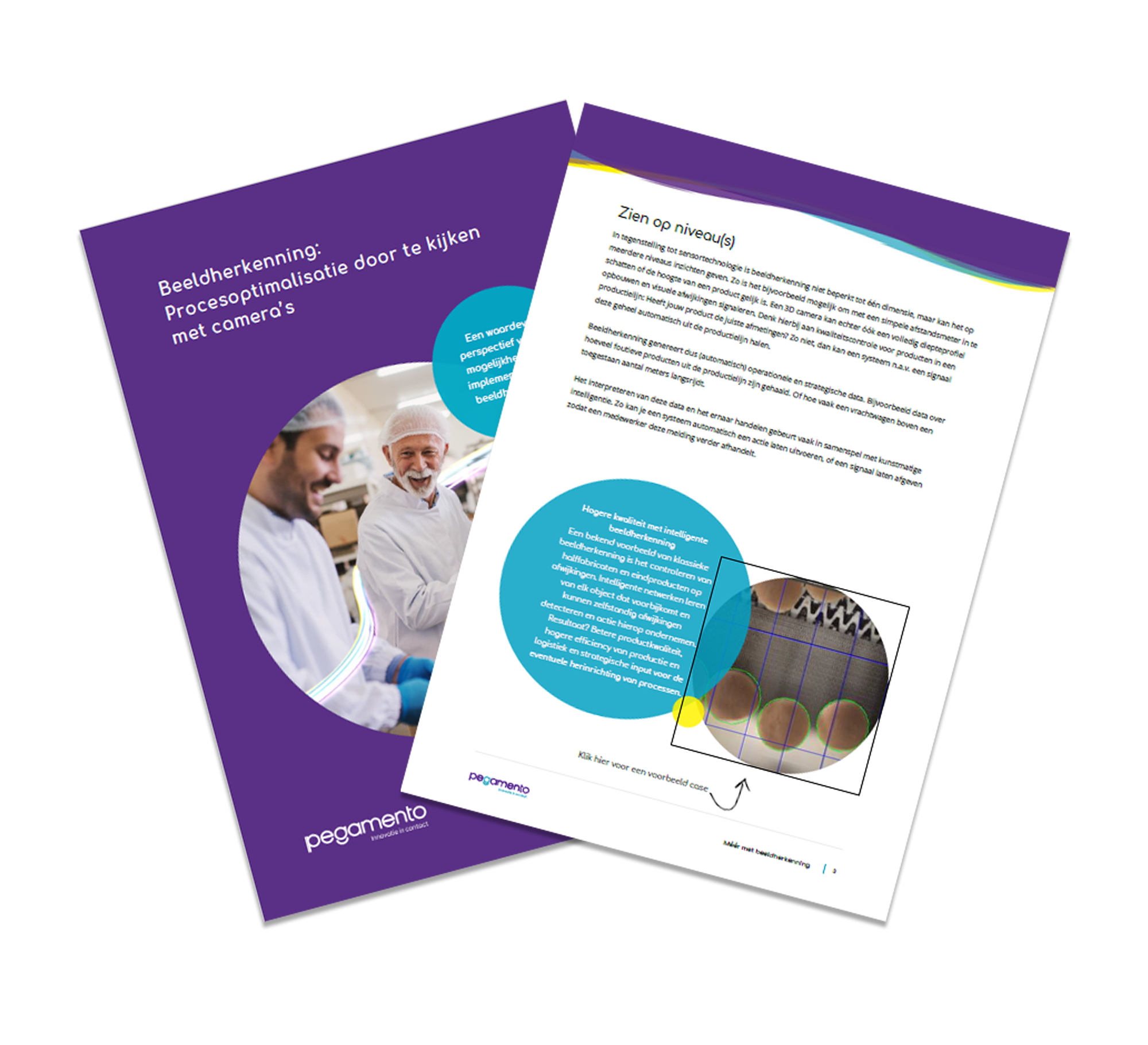
Yes, the possibilities are endless. This is just a small sampling of real-world applications. It won’t stop here either, because the technology is developing like crazy. In all examples, image recognition is the extra “eye” that looks with you. Whether it’s quality control of products or ensuring safety on a bridge. Wondering if image recognition can provide an extra eye within your organization? Then download our free white paper: Image recognition, process optimization by watching with cameras.
Free: Image recognition for dummies
Everything you want to know about image recognition.
[tcb-script charset=”utf-8″ type=”text/javascript” src=”//js.hsforms.net/forms/v2.js”][/tcb-script][tcb-script] hbspt.forms.create({ region: “na1”, portalId: “9343506”, formId: “5a14daaf-e597-471e-b5cf-1c712a072516” });[/tcb-script]